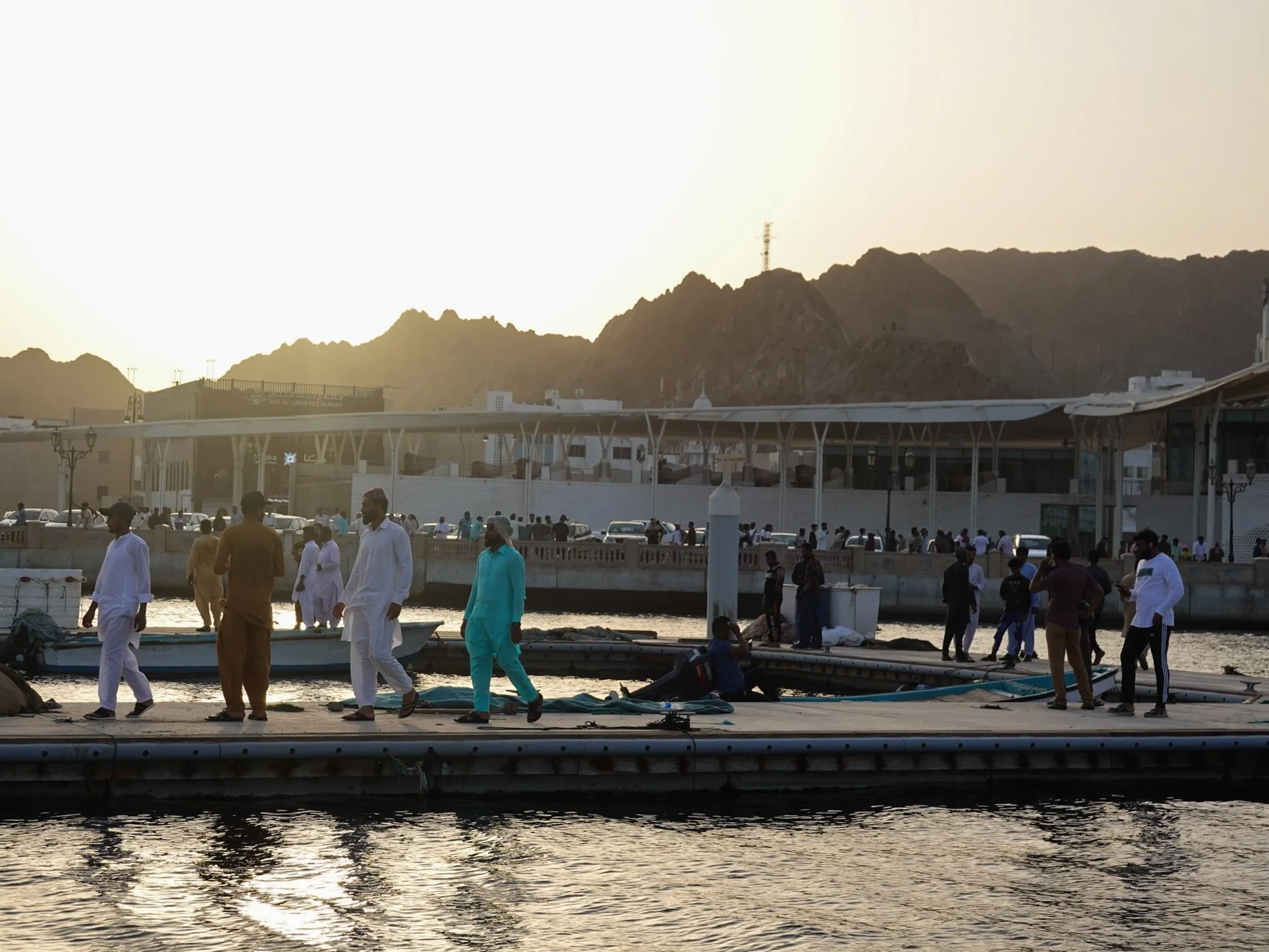
Heat changes everything about how a place moves. In Oman, life happened in the edges of the day. The city exhaled at dusk and came to life, awakening from its ghostly midday quiet. Walking along as temperatures finally dropped to a crisp 85°, hundreds of people stared. My friend and I were salmon swimming against a current we hadn't known was there: everyone around us was a man. It was a disorienting sensation, being inside a social architecture built without you in mind. This is what I find most valuable about travel. Not the landmarks or the food — though I do enjoy both — but the way it informs your own opinions about societies you'd otherwise only read about.
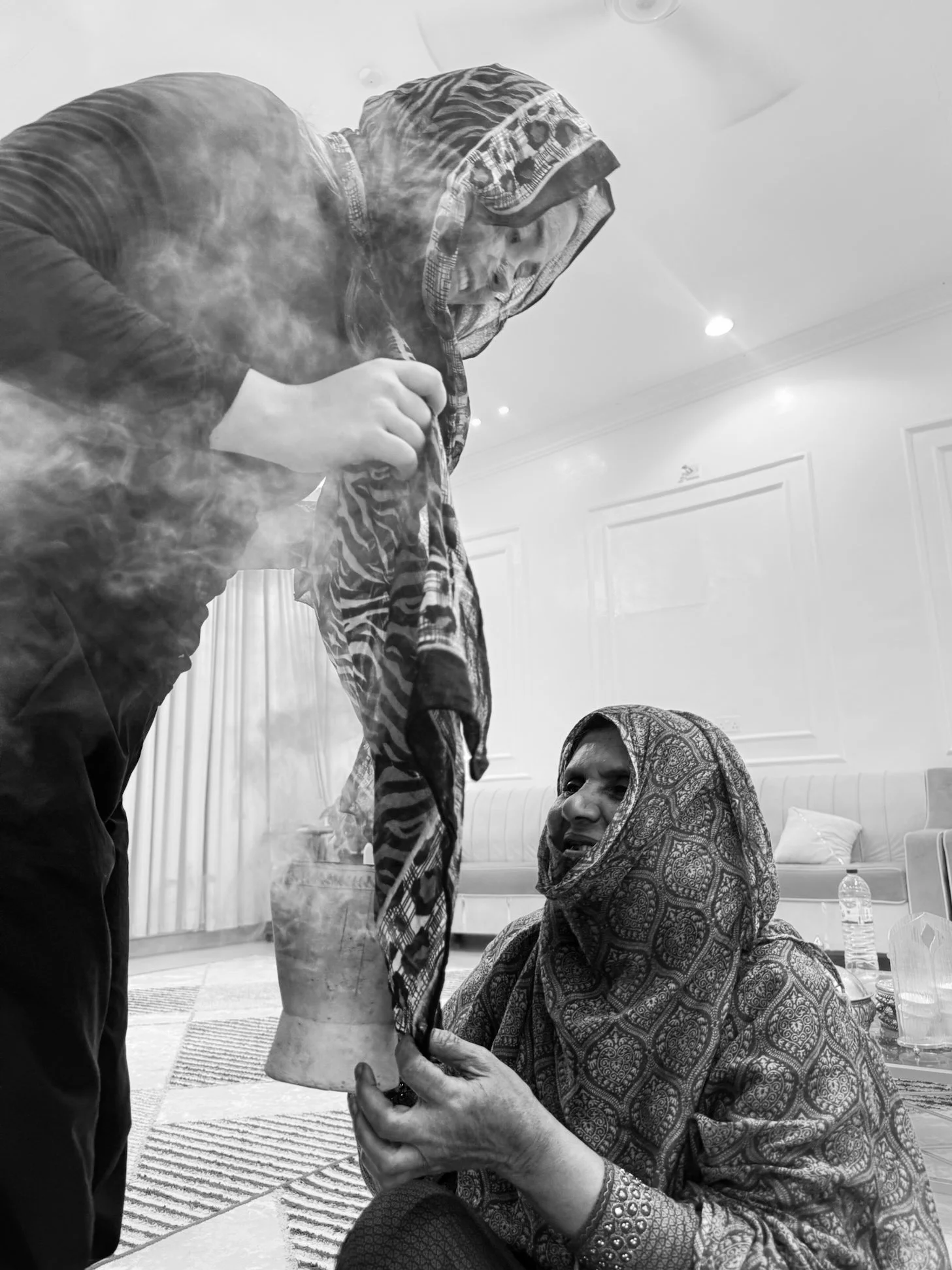
Because there were so few women visible in public, those I did encounter stood out. An Egyptian woman in our hotel pool spoke to us about Islam, her life, her choices. She felt genuinely free raising her children, managing her household, and spending her husband’s money on her own terms rather than selling her youth to a meaningless job. Her husband sat nearby and never once looked at us out of respect for her. I found it difficult to reconcile with my own instincts about what freedom means in my culture. Then three Iranian women on a beach gifted us mangoes, headscarves nowhere in sight, warm and laughing. A Saudi mother traveling with her family spoke with us at length about how dramatically her country had changed in just a few short years. At a grocery store, little girls ran laughing through the aisles, hiding things in strangers' baskets and spraying people with fake snow. I watched them and felt a complicated sadness, wondering whether their wildness would survive adolescence here. An elderly Omani woman at her home spread orange paste across our faces, lined our eyes with kohl, then lit bakhoor — a traditional incense — and wafted the fragrant smoke beneath our hijabs and abayas in a ritual of welcome. And in a hospital waiting room, female doctors moved through the room in full burqas like dancing shadows.
Traveling through conservative Oman as a foreign woman, I discovered I didn’t fit the existing categories. Local women operate within specific, well-understood social codes. Foreign women are not men, but not women in the traditional sense either, a recognized outside case the culture accommodates without fully integrating. In practice, this meant a strange double freedom: conspicuously visible, yet somehow exempt from the rules.
The Sultan Qaboos Grand Mosque made this clearer than anywhere else. I arrived wearing what I'd worn to mosques previously without issue: an ankle-length skirt, a long-sleeve top, and a gold silk hijab I'd bought in New Delhi. A guard sent me back for my ankles showing. I returned with tall socks. He sent me back again. I switched to hiking boots. He stared at me for a long moment, visibly weighing it, and then begrudgingly waved me through. I was never trying to be disrespectful — my research and previous mosque visits had suggested I was more than appropriately covered — but I was operating within a set of rules I didn’t fully understand. The mosque itself, once I was finally inside, was staggeringly beautiful. Almost no other tourists had been brave enough to come in June. Sweating underneath all of my required attire, I understood why.
The mosque had its own internal logic that I was operating on the edges of. Everywhere else, the edges worked in our favor. We were the only women swimming at Wadi Shab and Bimmah Sinkhole, so we went cliff-jumping alongside the men. We later stumbled upon local boys jumping off a bridge in Sur and climbed over the railing to join them. They cheered, then asked for dozens of photos, something an Omani woman would rarely permit of strangers. I walked away after a few minutes when the requests became endless. I'm glad I did: one of them later took his photo with Nastia and, along with some of her social media pictures, fabricated an elaborate story about their relationship on social media. After a bit of arguing online about respect for women, he deleted it. Privacy — especially for women — is incredibly important in Arab culture, but these boys recognized a new set of guidelines because we were foreigners, allowing them to temporarily circumvent their own norms in a way they wouldn’t with local women. Traveling in places where men and women are so separated can be difficult; how do we explain to young teenagers that we can be friendly without it being an invitation? Can we break some of these gender boundaries while still expecting other aspects to remain intact?
One evening, a man named Muhammad invited us to sit with his friends outside a mosque, drink tea, and play cards on a rug on the beach. It would never have been acceptable for a local woman to sit with them, but we were yet again performing a delicate balancing act between Oman's strong social architecture and its even stronger emphasis on hospitality. When Muhammad offered to drive us at 1AM to find hatching turtles, we went, understanding that following a stranger into the Middle Eastern desert at night could end badly or become an amazing travel story. He and his friend Fael led us to a dark beach where enormous sea turtles crawled up from the ocean to lay their eggs, ancient and unhurried. We sat there in silence for hours. Some moments don’t need commentary.
The next morning Fael took us surfing, then onto his boat — which he launched by driving his car at full speed down the beach and ramming it into the hull. We swam with what felt like hundreds of sea turtles. Then, rounding a headland, we found the dolphins, dozens of them playing in the bow wake, close enough to touch. I stood at the front of the boat and didn't take a single photo for several minutes, which for me is saying something.
I used to over-plan everything. Rigid itineraries, backup options, color-coded spreadsheets. When Fael suggested we spontaneously abandon our plans and follow him to Masirah Island for a few days, the old version of me would have hesitated. But we went.
Masirah is the kind of place that makes you wonder why you've spent so much of your life going where others tell you to go — deserted coastline, clear water, no tourists except a small cluster of kite surfers whose presence felt like its own kind of miracle: a European woman who'd grown up in Muscat, two Colombian teenagers living as expats in Dubai, and the Australian couple who ran this uniquely-located kite surfing school. I sat with them and thought about all the different architectures a life can take, how many ways there are to grow up simultaneously belonging to multiple places and fully belonging to none. I know something about that.
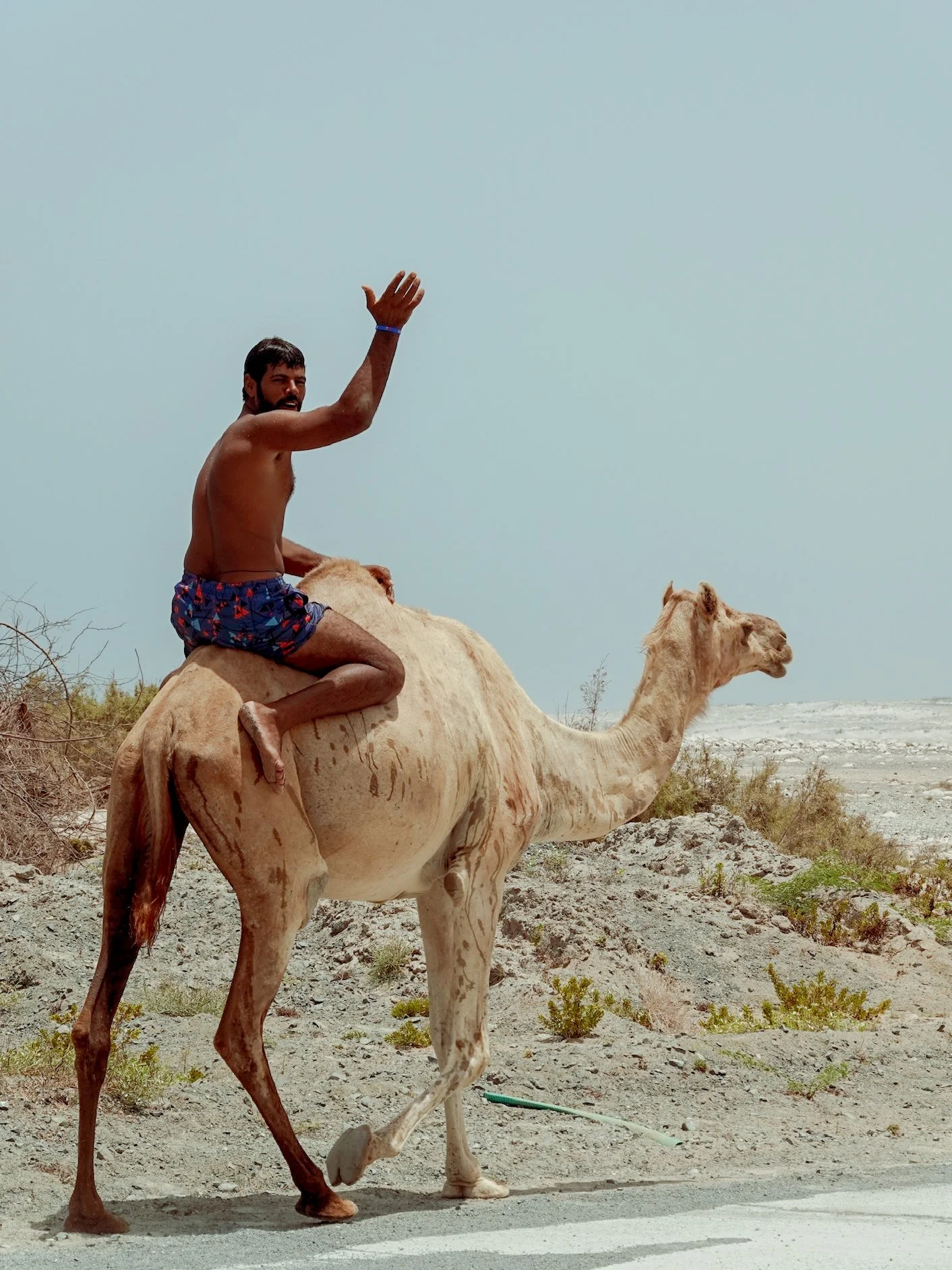
The best moments of the trip were all unplanned. Wild camels materialized from the landscape while we showered at a well in the middle of nowhere. Fael jumped effortlessly onto one and rode it in a lazy circle. I got halfway on when the camel turned its head, looked at me with magnificent disdain, and made its feelings known. We went our separate ways.
A local woman wouldn’t have done any of this. We could, because the rules that governed her life had been quietly suspended for us. What does it mean that we travelers moved so freely through a world built around her restriction? Are we some un-described third gender, toeing the line between modest female and adventurous man? I don’t have an answer, but the question sits with me long after my passport is stamped and the plane lifts off.
There’s a version of this story that ends with tidy lessons about how travel dissolves difference and reminds us of our shared humanity. I’m suspicious of that version. What I’ll say instead is that by the time I left Oman, I’d been stared at on a corniche, turned away from a mosque for uncovered ankles, fed constantly by strangers, driven into the desert to see turtles, slept on a beach under the stars, had my face painted orange by an elderly local woman, and sat in a hospital watching female Omani doctors work on my friend. The country I left was more complicated and more generous than the one I thought I was arriving in. I’m still not sure where I fit inside its architecture, and maybe that search for understanding is the greatest souvenir I brought home.